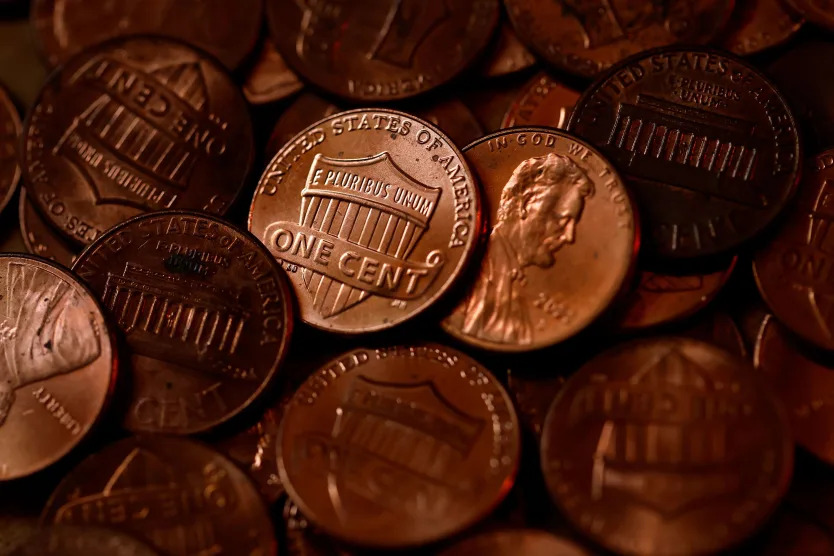
US copper-colored penny
OP-ED | By Dr. Michael O. Omoruyi
Philadelphia, USA — November 12, 2025
History quietly shifted today in Philadelphia. With a single metallic strike, the United States Mint produced the last-ever one-cent coin, ending a tradition that began in 1793. The tiny copper-colored penny—long mocked, long sentimental, and long economically wasteful—has finally reached its end.
For Americans, it marks the close of a 232-year chapter.
For the world, especially Africa and its diaspora, it raises deeper questions about value, change, and the future of money.

A FINAL STRIKE AND A FINAL STATEMENT
As U.S. Treasurer Brandon Beach oversaw the final minting, he announced it with a flourish: “God bless America, and we’re going to save the taxpayers $56 million.”
He was not exaggerating.
Each penny cost nearly four times its value—3.69 cents to make a 1-cent coin. At a time when digital payments dominate everyday life, the penny had become a relic sustained more by nostalgia than necessity.
The U.S.—the world’s largest economy—has finally admitted what the numbers have long proven: small coins can become big liabilities.
A SYMBOL OF THE OLD ECONOMY FALLS
The penny was first minted as the United States was still defining itself as a nation. It survived wars, depressions, inflations, booms, and a digital revolution.
But sentimentality cannot defeat economics.
-
It was expensive to produce.
-
It slowed transactions.
-
Businesses increasingly refused to handle it.
-
Consumers rarely used it except to weigh down pockets or hide in jars.
Its retirement is not just a financial decision—it is a cultural milestone. One of the most iconic symbols of American currency has been retired in the digital age.
LESSONS FOR AFRICA AND THE DIASPORA
Why should Africa and its far-flung diaspora care about America’s penny funeral?
Because this moment reflects a global shift that disproportionately affects emerging economies:
Currency must evolve with society
If a superpower concludes that a coin is obsolete, what does that say about African currencies struggling with inflation, production costs, and outdated denominations?
Many African nations still mint coins that cost more to produce than they are worth.
Digital transactions are redefining value
Mobile money already drives Africa’s fintech revolution—from M-Pesa in Kenya to rapid digital wallet adoption in Nigeria, Ghana, Rwanda, and South Africa.
Retiring the penny symbolizes what Africa has already begun: moving small-value transactions into digital spaces.
Monetary policy must be forward-thinking
The U.S. decision signals a trend: legacy currency systems are shrinking as cashless ecosystems expand.
African governments must ask:
-
Which denominations remain economically viable?
-
Is it time to modernize currency?
-
How do we protect vulnerable populations while transitioning toward digital economies?
Culture must not obstruct progress
Just as Americans loved their penny, Africans love their familiar notes and coins. But sentiment cannot block innovation.
THE END OF THE PENNY IS A MESSAGE
It is not simply the retirement of a coin.
It is a reminder that every society must confront what no longer serves it.
The U.S. penny lingered for decades because change is uncomfortable.
But a world increasingly driven by fintech, cryptocurrency, AI-powered banking, and digital wallets cannot cling to 18th-century instruments.
Africa—home to the world’s youngest population and some of its fastest-growing tech hubs—is uniquely positioned to leapfrog outdated monetary structures.
The penny’s death is a signal: Adapt early or be forced to adapt later.
A NEW AGE OF MONEY
As billions of existing pennies continue circulating until they fade naturally from wallets and jars, America moves a step closer to a streamlined, digital-first monetary ecosystem.
And for Africa and its diaspora, the question now is not whether to follow, but how quickly.
The tiny coin that once symbolized thrift, hope, and patriotic pride has minted its last moment. Its exit is a quiet but powerful reminder:
Economies that refuse to evolve eventually pay the price—literally.
By Dr. Michael O. Omoruyi
For iNewsAfrica
Follow iNewsAfrica channel on WhatsApp:
https://whatsapp.com/channel/0029VbAPrqI96H4JXXQrKP1V




Leave a reply


Email: [email protected]