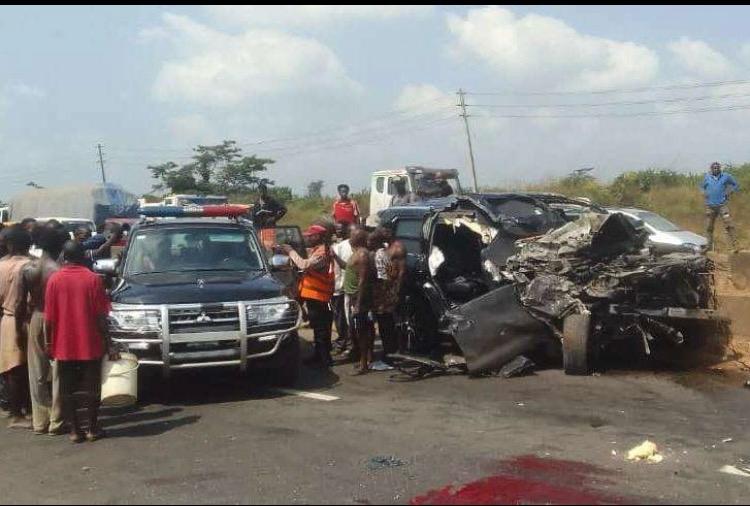
Aftermath of a deadly crash on a Nigerian highway, where mangled vehicles and bystanders underscore the human cost of reckless driving, weak enforcement, and poor road safety standards.
By Dr. Michael Omoruyi | iNewsAfrica Op-Ed
The tragic road accident that recently claimed the lives of close friends of Anthony Joshua on a Nigerian highway is more than a heartbreaking personal loss. It is a stark reminder of a national emergency we have normalized for far too long: unsafe roads, weak enforcement, and a dangerously low culture of road safety.
Every year, Nigeria’s highways become silent graveyards—lives cut short not by fate, but by avoidable failures. Overspeeding, reckless overtaking, drunk driving, poor vehicle maintenance, and the near-total disregard for traffic rules have become routine. These are not isolated behaviors; they are symptoms of a broken system that has failed to prioritize human life.
Laws Without Consequences Are Merely Suggestions
Nigeria does not lack traffic laws. What it lacks is consistent enforcement and meaningful deterrence. When traffic violations are met with bribes instead of penalties, when unroadworthy vehicles remain on highways, and when drivers face little fear of consequences, impunity thrives. The result is predictable—and deadly.
Stricter laws must be enacted and, more importantly, enforced without exception. Speed limits should be monitored with modern technology. Drunk and drug-impaired driving must attract severe penalties. Commercial drivers who endanger lives should face license revocation, not warnings. Road safety agencies need independence, funding, and political backing to do their jobs without interference.
Education: The Missing Link in Road Safety
Law enforcement alone is not enough. Nigeria urgently needs a national road safety education framework—from primary schools to driver licensing centers. Road safety should be taught as a civic responsibility, not an afterthought. Many drivers on our roads today were never properly trained, tested, or re-certified.
Driver education programs must be standardized, digitized, and monitored. Periodic re-testing should be mandatory, especially for commercial drivers. Public awareness campaigns—using radio, television, social media, and community outreach—must reinforce a simple truth: reckless driving is not bravery; it is violence.
Infrastructure, Accountability, and Leadership
Beyond behavior and enforcement, poor road infrastructure continues to magnify risks. Badly lit highways, potholes, missing road signs, and abandoned construction zones turn minor errors into fatal crashes. Government accountability is non-negotiable. Roads must be designed, maintained, and audited with safety as the primary metric—not political optics.
Leadership also matters. When policymakers, celebrities, institutions, and the media speak with one voice about road safety, culture begins to change. The loss connected to Anthony Joshua’s circle has drawn global attention, but thousands of nameless Nigerians die on these same roads every year without headlines.
A Line Must Be Drawn
Nigeria must decide: will our highways remain corridors of death, or pathways to progress? Stronger laws, uncompromising enforcement, comprehensive education, and safer infrastructure are not luxuries—they are moral imperatives.
We owe it to those who have died, to those who mourn them, and to the millions who travel Nigeria’s roads daily. One life lost is too many. Silence and inaction are no longer acceptable.
About the Author
Dr. Michael Omoruyi is a technologist, educator, author, and public affairs commentator focused on governance, safety, and sustainable development in Africa. He is the founder of iNewsAfrica and author of From Grit to Grace: A Memoir of Roots, Resilience, and Reinvention.
Follow iNewsAfrica channel on WhatsApp:
https://whatsapp.com/channel/0029VbAPrqI96H4JXXQrKP1V




Leave a reply


Email: [email protected]