How Artificial Intelligence Is Moving From Vision to Real Economic Value Across the Continent
By Dr. Michael O. Omoruyi
iNewsAfrica Africa
Executive Summary
The global workforce is entering a new era where artificial intelligence no longer functions merely as a tool, but as an autonomous collaborator capable of reasoning, adapting, and executing complex tasks. This “agentic” shift will redefine productivity, employment, and economic competitiveness. For Africa, it presents a historic opportunity to leapfrog traditional systems—if the continent invests in digital infrastructure, workforce reinvention, and ethical AI governance.
“The future of work is not automated — it is agentic. And Africa’s readiness will determine whether it leads or lags in the next global economy.”
From Tools to Teammates: The Rise of Agentic AI
For decades, technology in the workplace focused on automation — replacing repetitive human tasks with software efficiency. That phase is ending.
We are now entering the agentic age: where AI systems act with contextual understanding, decision-making capability, and autonomous initiative. These systems do not simply respond to commands; they collaborate, learn, and optimize outcomes in real time.
In the modern workplace, agentic AI will:
-
Initiate and manage workflows
-
Analyze complex data for strategic insight
-
Adapt based on outcomes
-
Support human decision-making at scale
This is not workforce replacement — it is workforce amplification.
“The competitive advantage of the next decade will belong to organizations that master human-AI collaboration.”
Africa’s Leapfrog Opportunity
Africa is uniquely positioned for this transformation.
With the world’s youngest population and expanding digital adoption, the continent can build AI-native industries without the burden of outdated legacy systems.
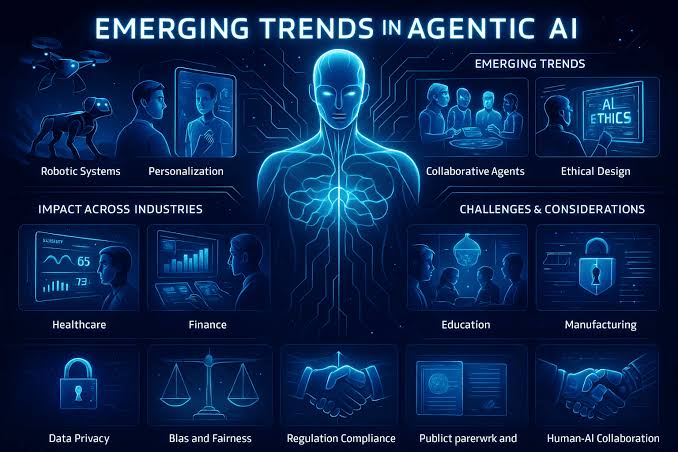
Agentic AI holds transformative potential across key sectors:
Healthcare
Intelligent agents can assist diagnosis in rural clinics, forecast disease outbreaks, and streamline medical supply chains.
Agriculture
AI systems can optimize planting cycles, predict climate shifts, and connect farmers directly to markets.
Finance
Autonomous compliance and fraud-detection tools can strengthen digital banking and expand financial inclusion.
Education
Personalized AI tutors can bridge teacher shortages and tailor learning across languages and cultures.
The question is no longer if AI will transform Africa’s workforce — but who will control that transformation.
Turning Vision Into Measurable Value
Conferences alone will not build the future of work. Execution will.
To translate agentic AI from promise into prosperity, Africa must prioritize three core pillars:
Workforce Reinvention
AI literacy must become foundational — embedded across schools, universities, and vocational training.
Tomorrow’s professionals must know how to:
-
Supervise AI systems
-
Collaborate with intelligent agents
-
Apply ethical judgment to automated outcomes
Digital Infrastructure Sovereignty
Broadband access, cloud capacity, and local data centers are now economic necessities.
Without infrastructure, AI cannot scale.
Without data ownership, Africa risks digital dependency.
African AI must be trained on African realities.
Ethical and Regulatory Leadership
Autonomous systems demand accountability.
Forward-looking governance must ensure:
-
Data privacy protection
-
Bias-free algorithms
-
Worker transition safeguards
-
Transparent automated decision-making
Responsible AI will define sustainable growth.
“If Africa does not own its AI future, it will rent it — at the cost of economic sovereignty.”
Redefining Work and Human Potential
Agentic AI will shift labor away from routine tasks toward creativity, strategy, empathy, and leadership.
The future workforce will value:
Human judgment + Emotional intelligence + AI fluency
Together, humans and intelligent agents will generate unprecedented productivity.
This is not the end of work.
It is the elevation of work.
A Call to African Leadership
To thrive in the agentic era:
-
Governments must shift from reactive regulation to proactive AI strategy
-
Businesses must integrate AI responsibly
-
Universities must modernize curricula
-
Startups must build African-centered solutions
Most importantly, Africa’s youth must see themselves as creators — not consumers — of this new technological order.
Final Thought
The future of work is agentic.
It will reward preparation.
It will expose hesitation.
It will redefine global competitiveness.
Africa must not merely adapt.
Africa must lead.
About the Author
Dr. Michael O. Omoruyi is a technology strategist, author, and publisher of iNewsAfrica. He is the author of From Grit to Grace: A Memoir of Roots, Resilience, and Reinvention, and a leading advocate for digital transformation, AI ethics, and African innovation. Dr. Omoruyi writes extensively on technology, governance, and socio-economic development across the African continent.


Leave a reply


Email: [email protected]